Custom Build vs HubSpot: When a Tailored System Wins
Choosing the software that runs your sales, marketing, and operations is one of the biggest decisions a growing company makes. Most teams reach the same fork: adopt an all-in-one platform like HubSpot, or build a system designed around how you actually work. AI is pushing more companies toward the second option. McKinsey reports that 65% of organizations now use generative AI regularly, nearly double the share from a year earlier, and overall AI adoption has climbed to 72%. Businesses want systems that act on data, not just store it.
That shift changes what teams expect from their core software. They want workflows that run themselves and insights that surface on their own. A custom build delivers exactly that, shaped to your processes instead of someone else’s template.
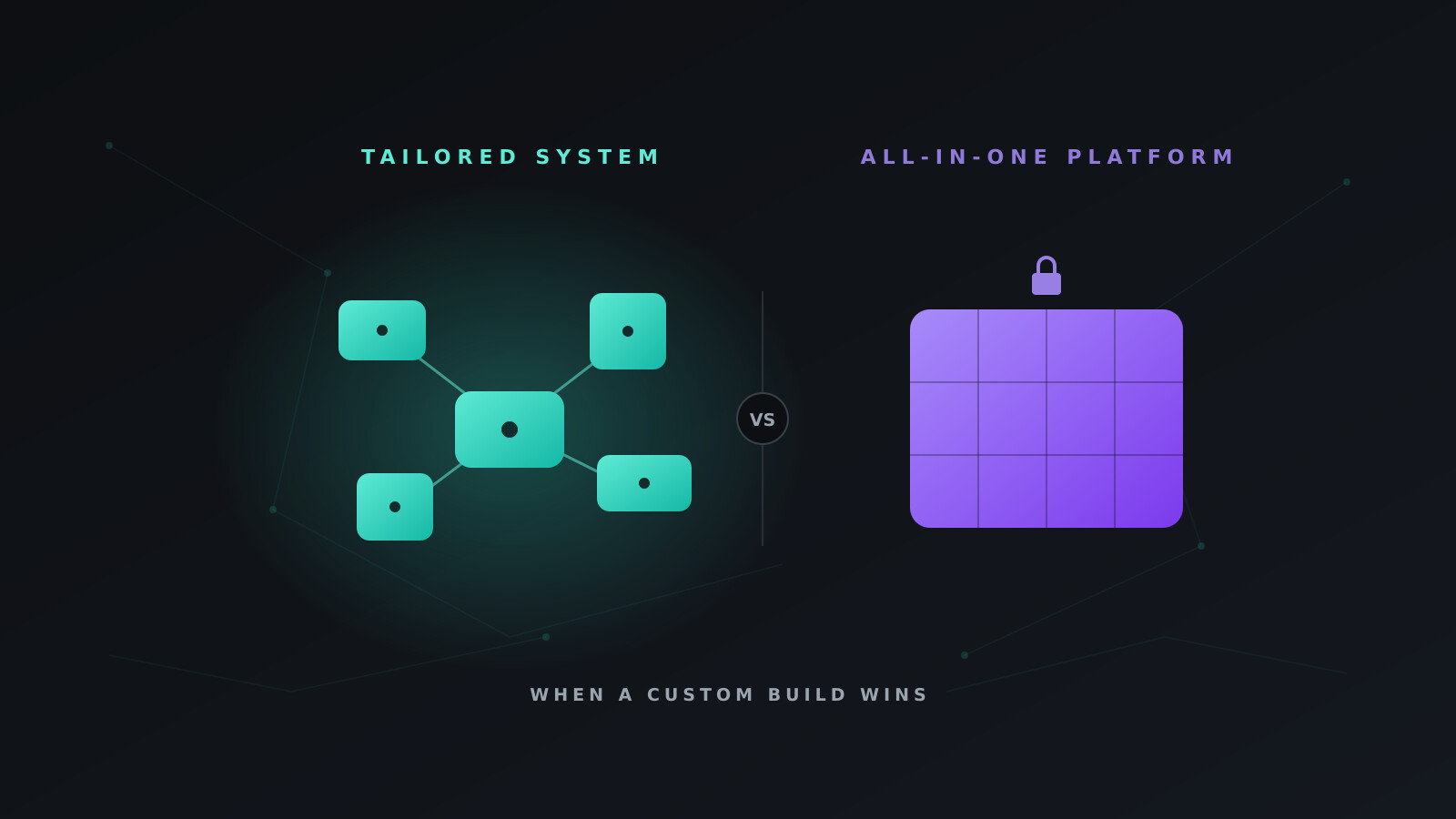
The decision still isn’t simple. Off-the-shelf platforms come with rigid data models, rising per-seat costs, and integration gaps that create data silos. The real question behind custom build vs HubSpot is long-term scalability, total cost of ownership, and a system that works for your team rather than the other way around.
| Agency | Location | Best For | Notable Clients | Strength |
|---|---|---|---|---|
| Brixx Digital | Ohio, USA | Businesses needing custom portals and AI automation | Founding Access partners | Blueprint-first custom system design |
| CodeAutomation.ai | Chicago, IL | Tailored HubSpot strategies and AI automation | Not specified | AI-driven HubSpot automation |
| Slashdev.io | Remote | Teams needing custom AI agents for HubSpot | Not specified | Rapid AI agent deployment |
| Triario | Global | Global consultancy for CRM and AI agents | Not specified | HubSpot Elite Partner with ISO certs |
| GSI | Houston, TX | Net-new HubSpot implementations and portal rescues | Not specified | Diamond HubSpot Solutions Partner |
| 011BQ | Remote | B2B companies hitting HubSpot’s limits | Not specified | Direct custom CRM alternative focus |
The Trade-Offs Nobody Mentions Up Front
The choice between HubSpot and a custom system rarely comes down to one factor. Most teams weigh a stack of technical and financial trade-offs. Knowing the common hurdles up front helps you pick a path that supports growth instead of creating new bottlenecks.
- Integration complexity: Getting HubSpot to talk to your existing stack is the first real test. Mismatched data models, inconsistent APIs, and legacy tools create silos that distort reporting and slow cross-team work. A custom system builds those connections in from day one.
- Restrictive customization: HubSpot is feature-rich, but your processes often have to bend to its structure. Companies with unusual sales cycles or specialized service delivery hit those limits fast. The result is brittle workarounds that cost time.
- Vendor lock-in and rising costs: Subscription pricing climbs as you grow. Per-user fees, contact-tier jumps, and required onboarding charges add up. Over time, the cost of leaving rivals the cost of staying, which is a core concern in any custom build vs HubSpot decision.
- Data migration: Moving years of customer and operational data into HubSpot demands careful planning. Rush it and you risk data loss, corruption, and integrity problems that erode team trust in the new system.
- User adoption: A powerful tool delivers nothing if the team avoids it. When software feels complicated or fails to make work easier, people resist it. That turns an expensive purchase into shelfware and kills your return on investment.
- Lack of competitive differentiation: An off-the-shelf platform hands your competitors the same workflows you run. A custom build lets you encode proprietary processes that become a real competitive moat.
- Data governance and compliance: Meeting industry rules like HIPAA or GDPR inside a rigid SaaS framework is hard. A tailored data architecture lets you build compliance in rather than bolt it on later.
- Limited custom AI and ML scaling: SaaS platforms cap how far you can deploy proprietary machine learning models. A custom system gives you the infrastructure to run advanced, business-specific AI.
1. Brixx Digital
Brixx Digital starts with a strategic Blueprint before anyone writes code. We build tailored AI systems, custom portals, and automation infrastructure that businesses run on. Instead of forcing your operations into a fixed box, we design the exact system you need, whether that’s a client onboarding portal, a sales pipeline command center, or an AI virtual employee. This portal-first, async-delivery model produces higher adoption, stronger efficiency, and a clear return on investment.
- Location: Ohio, USA
- Services: Blueprints (strategy and architecture), Builds (custom portals, AI automation), Brand (identity and content), and Business Intelligence (dashboards and insights).
- Pricing: Blueprints start at $497, credited toward a Build. Single-system Builds run $1,500 to $4,500; multi-system solutions run $5,000 to $9,000 and up.
Highlights
- No compromises: Your system is built only for your processes, data models, and goals.
- No bloat: You pay for the features you use and skip the clutter of an all-in-one suite.
- True data ownership: You own the system and the data outright, free from lock-in and surprise price hikes.
- Scales on your terms: No per-user or per-contact fees that punish growth.
- Deep integration: Built from the ground up to connect with your critical tools, ERPs, and legacy systems.
- Blueprint-first strategy: The opening Blueprint aligns the build with your objectives and de-risks the investment.
2. CodeAutomation.ai
CodeAutomation.ai is a HubSpot-centric agency built around AI-driven automation. They help businesses get more from HubSpot through custom CRM setups, data migration, and integrations with tools like ERP and e-commerce systems. Their focus is making HubSpot work harder, not replacing it.
- Location: Chicago, IL, USA
- Best for: Businesses already committed to HubSpot who want AI and deeper integrations.
- Services: HubSpot CRM setup and configuration, data migration, API integrations, AI-powered automation, custom reporting, training and support.
- Pricing model: Not publicly available; requires direct contact.
Highlights
- Strong AI-automation expertise inside the HubSpot environment.
- Connects HubSpot to a wide range of external systems.
- Full service span, from strategy to ongoing support.
Watch-outs
- Focus is enhancing HubSpot, not delivering a ground-up alternative.
- No public pricing, so early budgeting is hard.
- Wrong fit for companies whose problems stem from HubSpot’s core limits.
3. Slashdev.io
Slashdev.io builds custom AI agents that plug directly into a company’s HubSpot portal. Those agents automate tasks, deliver sales intelligence, and optimize campaigns across marketing, sales, and service. Their model runs on speed, getting custom AI live in weeks rather than months.
- Best for: Teams that want to add highly specific AI capabilities to their HubSpot portal.
- Services: Custom AI agent development, HubSpot AI automation, MVP development, custom software.
- Pricing model: Clear hourly rate of $50/hour.
Highlights
- Transparent hourly pricing suits project-based work.
- Rapid deployment delivers value faster.
- Specializes in custom AI agent development, a high-value service.
Watch-outs
- Business location is not listed, which matters to some buyers.
- Long-term support for these custom agents is still unproven.
- Augments HubSpot rather than building a standalone CRM.
4. Triario
Triario is a HubSpot Elite Partner that runs as a global consultancy with boutique agility. They cover CRM implementations, custom integrations, RevOps strategy, and custom AI agents. Multiple ISO certifications back their commitment to quality and security, which suits companies that need strong compliance and oversight around HubSpot.
- Best for: Companies that want strategic consulting and deep technical work on one HubSpot team.
- Services: CRM implementations and migrations, Revenue Operations (RevOps), custom integrations, custom AI agents, AI-ready website design.
- Pricing model: Not publicly available.
Highlights
- Elite Partner status signals verified, deep expertise.
- ISO certifications show enterprise-grade security and quality.
- Broad service range, from RevOps to custom AI.
Watch-outs
- Pricing is not transparent and requires a full consultation.
- A global firm may give less attention to smaller domestic businesses.
- The focus is tailoring HubSpot, not building from scratch.
5. GSI (Global Systems Integrator)
GSI holds Diamond HubSpot Solutions Partner status, the top tier in the ecosystem. They serve businesses that need full-scope work, from new implementations and portal rescues to ongoing RevOps management. They lean on HubSpot’s open APIs to build custom connections that extend the platform.
- Location: Houston, TX, USA
- Best for: Enterprises and mid-market companies that need a top-tier partner for complex HubSpot work.
- Services: HubSpot consulting and implementation, RevOps management, customization, managed services, training, data migration.
- Pricing model: Scope-dependent and not publicly listed.
Highlights
- Diamond status grants top-level HubSpot expertise and support.
- End-to-end services through a single point of contact.
- Strong use of open APIs for custom connections.
Watch-outs
- Pricing is fully bespoke and hard to compare up front.
- The focus stays inside HubSpot, not a full custom build.
- Often more than smaller businesses with simpler needs require.
6. 011BQ
011BQ takes the custom build vs HubSpot question head-on. They offer custom CRM development as a direct HubSpot alternative for businesses that have outgrown the platform. They serve B2B companies with unique pipelines, deep integration needs, or rising HubSpot costs at scale. Their consultative approach helps clients weigh the trade-offs and pick a direction.
- Best for: B2B companies with unique workflows who are questioning HubSpot as a long-term fit.
- Services: Custom CRM development, HubSpot vs. custom CRM consultation, custom data model and workflow automation, deep ERP and legacy integration.
- Pricing model: Starting estimates provided, with custom CRM builds from about $20,000.
Highlights
- Tackles the core dilemma directly, with services on both sides.
- Shares pricing estimates that frame the financial decision.
- Highlights custom-build benefits like data ownership and no per-user costs.
Watch-outs
- Location and industry focus are not clearly specified.
- The starting price is a sizable upfront investment next to a SaaS subscription.
- As a development shop, they put less emphasis on marketing and content.
What to Consider When Choosing HubSpot or Custom
The right choice depends on your context: operational complexity, growth trajectory, and technical resources. A few direct questions point to the best path.
Start with your workflows. Are your sales, service, and marketing processes standard, or do you run a multi-stage onboarding process, complex quoting logic, or a non-traditional sales cycle? Standard playbooks fit HubSpot well. When your process is your competitive advantage, a custom system built around it returns more.
Next, run the total cost of ownership math. Don’t compare a monthly HubSpot fee to the upfront cost of a build. Project both over three to five years. Add HubSpot’s per-user fees, contact-tier increases, and required professional services. For a custom build, add development plus a smaller, predictable hosting and maintenance fee. A custom system often wins on cost as your team and customer base grow.
Finally, weigh integration and data ownership. If you rely on proprietary or legacy software without standard HubSpot connectors, a custom build is often the only route to one unified data environment. And if full control of your data is a strategic priority, a custom system is the only option that guarantees it and ends vendor lock-in.
The choice is strategic. For some teams, HubSpot is the perfect fit. For others, it’s a stepping stone before they build the system that powers their next stage of growth.
The fastest way to find your path is an expert-led review of your current systems and goals. A Brixx Digital Blueprint gives you the clarity and technical specification to make the right long-term investment. Configure your system today and see what a tailored solution looks like for your business.
Frequently Asked Questions (FAQs)
What are the business advantages of a custom CRM over HubSpot?
The biggest advantage is flexibility. A custom CRM is built only for your processes, data models, and workflows, so your operations never bend to fit the software. That alignment drives higher adoption, cleaner data, and proprietary workflows competitors can’t copy, which becomes a real competitive edge.
When is HubSpot a better choice than a custom build?
HubSpot suits startups and small to mid-sized businesses with standard sales and marketing processes. It delivers an integrated toolset out of the box at a lower upfront cost, so teams get running quickly without a dedicated development team.
Can a custom system use AI to automate my business processes?
Yes. A custom build gives you the infrastructure to deploy AI automation and proprietary models that rigid SaaS platforms restrict. You can automate onboarding, quoting, reporting, and routine decisions, with an AI virtual employee handling work that would otherwise need another hire.
Is a custom build more expensive than HubSpot?
It depends on the time frame. A custom build costs more up front, while HubSpot starts with a lower subscription. HubSpot’s costs climb with users and contacts; a custom build’s costs stay flat. Over three to five years, a growing business often pays less with a custom build.
How rapidly is AI adoption growing among businesses right now?
McKinsey reports that 65% of organizations now use generative AI regularly, nearly double the share from a year earlier, and overall AI adoption has climbed to 72%. That pace is pushing businesses to demand software that acts on data rather than just stores it.
What are the hidden cost risks of staying on an off-the-shelf platform as your business scales?
Off-the-shelf platforms carry rigid data models that force your processes to fit their structure, along with rising per-seat costs that grow with every hire. Both become significant constraints as a business scales and needs its core software to flex with it.