
Refrigerant Tracking Software for the EPA 15 lb Leak Rule
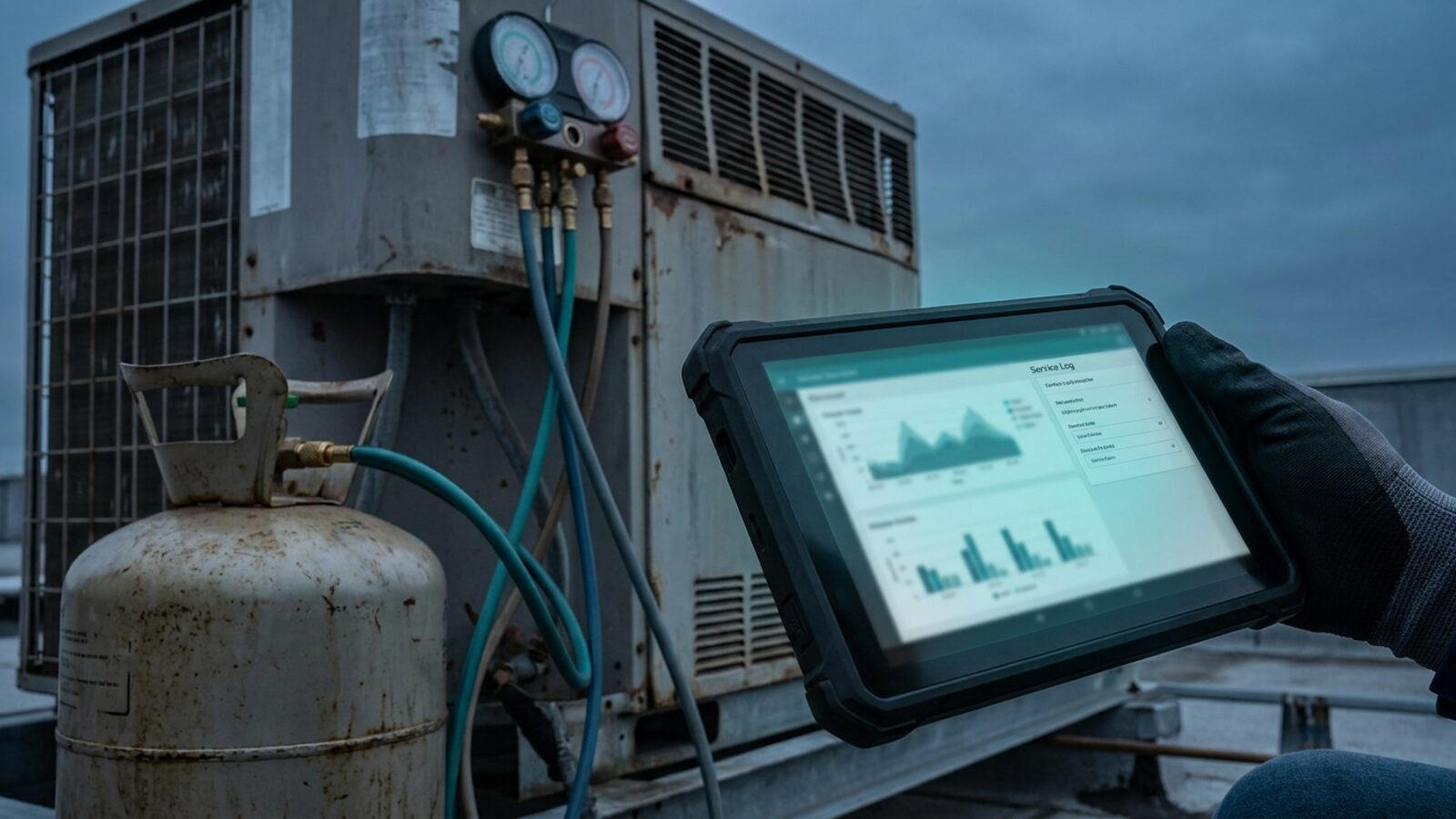
Commercial HVAC compliance stopped being an annual paperwork drill. The AIM Act requires an 85% phasedown of U.S. hydrofluorocarbon production and consumption by 2036, and since January 1, 2026 the federal leak repair rules start at 15 pounds of refrigerant charge instead of the old 50. Mid-size rooftop units that sat outside the rules last year are reportable assets now.
Under the Clean Air Act, penalties run per violation and per day, so an incomplete log is not a filing annoyance. The work lands on the technician holding the gauge: exact weights, cylinder IDs, and leak rate math captured at the job site, then kept on file for three years. Paper tickets and a shared spreadsheet do not survive an inspection.
Here are seven options for a digital logbook for commercial refrigeration, from custom compliance portals to enterprise refrigerant registries.
| Provider | Best for | Leak rate calculation | Records & audit trail | Starting price |
|---|---|---|---|---|
| Brixx Digital | AI-driven HVAC compliance & automation portals | Automated, built to your assets | Three-year portal, export ready | Blueprint from $1,500 |
| Trakref | Enterprise refrigerant compliance and ESG reporting | Automated | Full cylinder lifecycle | Not published |
| ServiceTitan | Commercial HVAC contractors | Custom required fields | Ticket-level history | Not published |
| Accruent | Grocery & industrial refrigeration | Automated | Enterprise asset reporting | Not published |
| ServiceChannel | Multi-site facility owners | Vendor reported | Work order records by site | Not published |
| Eptura Asset (Hippo CMMS) | Internal maintenance teams | Manual fields | Asset service history | Not published |
| Fexa | Retail & restaurant portfolios | Configurable workflows | Vendor compliance records | Not published |
What the EPA 15 lb Rule Actually Requires
The refrigerant management rules under the AIM Act live in 40 CFR Part 84, subpart C. The leak repair and recordkeeping duties have been in force since January 1, 2026. You can read the current text on eCFR.
The short version:
- 15 lb threshold. Appliances holding 15 pounds or more of a refrigerant with a Global Warming Potential above 53 fall under the leak repair rules. The old Section 608 threshold was 50 pounds, so thousands of mid-size rooftop units are newly covered.
- Leak rate thresholds. EPA sets a separate annual leak rate for comfort cooling, commercial refrigeration, and industrial process refrigeration. Cross the rate that applies to your equipment class and you owe repairs plus a verification test. Confirm the current figure for your class against EPA Section 608 and AIM Act guidance before you set your alert levels.
- Three-year records. Service records, leak rate calculations, and cylinder logs stay on file for at least three years.
- Automatic leak detection. New appliances holding 1,500 pounds or more need ALD hardware installed.
Every service call has to produce the same fields: date of service, type of service, the calculated leak rate, pounds added or recovered, technician certification, and the cylinder used. Miss one and the record is incomplete.
Where Manual Compliance Workflows Break
These rules expose every crack in a paper process. Five failures show up again and again.
- Guessed weights. A technician on a 95-degree roof writes an estimate instead of a scale reading. That number becomes your official federal record.
- Hand-run leak math. An annualized rate worked out on a ticket either triggers a false alarm or buries a mandatory repair deadline until it passes.
- Retyped data. The field service app does not sync with the compliance registry, so the office keys everything in a second time. One transposed digit turns a clean repair into a missed threshold on paper, and paper is what an inspector reads.
- Forms stacked on the technician. An hour of compliance paperwork after a ten-hour day is administrative load your best people never signed up for, and it is one of the reasons they take the next offer that comes along.
- Vanishing records. Cylinder logs sit on one laptop or in a filing cabinet. When that employee leaves, the audit trail goes with them.
1. Brixx Digital
A compliance system works when it matches how your crews already work. Brixx Digital builds custom portals and AI-driven automation for trade and service businesses. Instead of bolting a third-party app onto your dispatch board, the compliance layer sits inside the workflow your team opens every morning.
Work starts with a Blueprint. We map how field data moves from the technician’s phone into a three-year audit trail, then build to that spec. Automated leak rate calculation runs the moment a weight is entered, and managers get one view of high-risk assets and open repair deadlines across every commercial site.
Best for: Commercial HVAC operators and multi-location service businesses whose workflow no off-the-shelf tool matches.
Starting price: Blueprint from $1,500, credited toward the build. The build is quoted from that spec.
Standout features: automated 15 lb threshold checks and leak rate calculation, cylinder-level logging, CRM and invoicing integration, three-year audit dashboard.
Pros:
- Fits your operation instead of forcing a workaround.
- One interface for dispatch, invoicing, and compliance records.
- Calculates leak rates automatically, so nobody does percentage math on a roof.
Keep in mind:
- A custom build starts with scoping, so it is not a same-day signup.
2. Trakref
Trakref is a compliance platform built for one job: EPA Section 608 and AIM Act refrigerant compliance. It tracks the full life of a gas, from cylinder purchase through recovery, reclamation, or destruction, across large cooling footprints. Fexa acquired Trakref in 2023 and now sells it as Fexa Trakref, a module inside the Fexa platform reviewed at #7 below.
The platform works as a central registry for every cooling asset in an organization and updates its rule logic as state and federal requirements change. That suits companies with real environmental and ESG reporting obligations.
Best for: Enterprise organizations with dedicated environmental compliance staff.
Starting price: Not published.
Standout features: regulatory calendar updates, end-to-end cylinder tracking, refrigerant ESG reporting.
Pros:
- Purpose-built for refrigerant compliance and emissions reporting.
- Cylinder-level tracking cuts inventory loss.
- Applies the formula that matches each asset’s location.
Cons:
- The interface reads technical for a field technician in a hurry.
- You map every asset before the system earns its keep.
3. ServiceTitan
ServiceTitan runs the whole business: dispatch, estimates, invoicing, payroll. Its custom forms carry the compliance load. Managers mark refrigerant fields as required, and the technician cannot close the ticket without them.
Keeping compliance inside the main platform means no app switching on the roof. Every invoice ties back to a complete service log.
Best for: Commercial HVAC contractors who want operations and compliance in one system.
Starting price: Not published.
Standout features: required-field mobile forms, integrated invoicing, equipment history per customer.
Pros:
- No separate compliance app to buy or train on.
- Regulatory data attaches to billing and service history.
- Field-tested mobile app.
Cons:
- Big financial and operational commitment to deploy.
- Your admin team builds the EPA forms and the leak rate logic by hand.
4. Accruent
Accruent serves large refrigeration portfolios: grocery chains, cold storage, and industrial plants. Its asset management and compliance tools track refrigerant charge, leak events, and repair history across hundreds of locations.
This is enterprise software with enterprise assumptions. It pays off when refrigerant risk shows up on your corporate reporting, not just your service board.
Best for: Grocery, cold storage, and industrial operators with thousands of refrigeration assets.
Starting price: Not published.
Standout features: enterprise asset hierarchy, refrigerant and leak event tracking, portfolio reporting.
Pros:
- Built for very large asset counts across many sites.
- Rolls refrigerant data into broader facility and energy reporting.
- Flags chronically leaking equipment worth replacing.
Cons:
- Implementation runs long and needs internal project ownership.
- Too heavy for a regional HVAC contractor.
5. ServiceChannel
ServiceChannel is a facilities and vendor management platform for multi-site owners. Data organizes around the building and the asset, not the contractor, so the property owner keeps the records.
Facility teams use it to hold outside HVAC vendors accountable. Work orders, notes, and documentation stay attached to the rooftop unit even after you change service providers.
Best for: Property and facility directors managing outside contractors across many buildings.
Starting price: Not published.
Standout features: asset-centric records, vendor performance tracking, work order documentation by site.
Pros:
- Data ownership stays with the facility, not the contractor.
- Consolidates paperwork from multiple service providers.
- Clear history on equipment that keeps leaking.
Cons:
- Your contractors have to learn a portal they did not choose.
- Refrigerant fields depend on how well you configure them.
6. Eptura Asset (formerly Hippo CMMS)
Eptura Asset, sold as Hippo CMMS until Eptura retired that name for new customers, is a maintenance management system, not a refrigerant tool. Its asset module accepts custom fields, so a preventive maintenance ticket can prompt the technician for the EPA data you need.
This fits in-house teams at hospitals, schools, and plants that track everything from plumbing to high-tonnage chillers in one dashboard.
Best for: Internal facility maintenance teams covering many asset classes.
Starting price: Not published.
Standout features: interactive floor plans, preventive maintenance scheduling, parts and inventory tracking.
Pros:
- Handles all maintenance work alongside refrigerant records.
- Solid inventory tracking for parts and cylinders.
- Short learning curve for in-house staff.
Cons:
- Refrigerant compliance is a configuration project, not a feature you switch on.
- Leak rate math stays on your team unless you build the fields for it.
7. Fexa
Fexa is a configurable facilities platform for multi-site retail, grocery, and restaurant operators. In those buildings refrigeration is the business, and one leak costs product plus penalties. Fexa also owns the former Trakref refrigerant-compliance engine covered at #2 above, sold inside its platform as Fexa Trakref.
Fexa manages hundreds of outside vendors and routes their work through your rules. Configure it so a refrigeration technician supplies the required compliance data before the invoice moves to approval.
Best for: National retail, grocery, and restaurant brands running heavy commercial refrigeration.
Starting price: Not published.
Standout features: workflow configurability, vendor invoice approval routing, custom compliance fields.
Pros:
- Holds outside contractors to your reporting standard.
- Custom fields absorb state-level rules on top of federal ones.
- Portfolio-wide view of equipment health.
Cons:
- All that configurability means a steep setup and a steep learning curve.
- Oversized for single-site operators and small contractors.
What Actually Decides This
One question settles it: do you want a separate compliance app, or compliance built into the system your crews already use? A standalone registry digitizes the logbook this week. It also splits your data across platforms that do not talk, which is how retyping starts.
A custom portal puts the 15 lb threshold, the leak rate math, and the three-year record in the same place as dispatch and invoicing. Technicians never leave their workflow, and the audit file builds itself.
Ready to stop retyping cylinder weights? See our approach to compliance and records systems, or look at how we build for the commercial HVAC industry. Start with a Blueprint and you will know exactly what gets built before anyone writes code.
The simplest way to keep these records is to capture them on the service call itself. We build refrigerant logs into the dispatch and technician app for HVAC companies, alongside the other compliance and records systems a trade business needs.
Frequently Asked Questions (FAQs)
What is the EPA 15 lb refrigerant leak rule?
It is the leak repair requirement in the EPA refrigerant management rules under the AIM Act, in force since January 1, 2026. Owners and operators of appliances holding 15 pounds or more of a regulated refrigerant with a GWP above 53 have to find leaks, repair them, and verify the repair. The old Section 608 threshold was 50 pounds. New appliances holding 1,500 pounds or more also need automatic leak detection.
What must a technician record on every refrigerant service call?
The date of service, the type of service performed, the calculated leak rate, the pounds of refrigerant added or recovered, the technician’s certification details, and the cylinder used. An incomplete record fails an inspection even when the repair itself was done right.
How long do I keep refrigerant tracking records?
At least three years. That covers service records, leak rate calculations, and cylinder logs, and they have to be produced when an inspector asks.
How does AI and automation simplify EPA refrigerant compliance?
Automation takes over the steps people get wrong. It calculates the annualized leak rate the second a weight is entered, flags the asset that crossed its threshold, starts the repair clock, and files the record where an auditor can find it. AI sits on top of that history and surfaces the units that leak again and again, so replacement decisions rest on data instead of memory.
What is the best refrigerant tracking software for commercial HVAC?
There is no single winner, and the real split is whether you want a second app or compliance inside the system your crews already use. Trakref fits enterprises with dedicated environmental staff, ServiceTitan fits contractors who want one operations platform, and a custom portal from Brixx Digital fits operators whose workflow no off-the-shelf tool matches.
This is general information, not legal advice.